







































































In my linked column, I explored deep-space radiation as one of the greatest barriers to human spaceflight. Earlier this month, the Artemis II mission made that challenge suddenly, viscerally real.
The mission represents a significant milestone, as it is NASA’s return to crewed deep-space exploration for the first time in more than 50 years, with its first crewed journey around the Moon since the Apollo era. As part of its Artemis Program, NASA plans to establish a sustainable human presence on and around the Moon to build long-term infrastructure, including a permanent base camp at the lunar South Pole, and use it as a stepping stone to prepare for future missions to Mars.
There and Back Again: A Significant Milestone
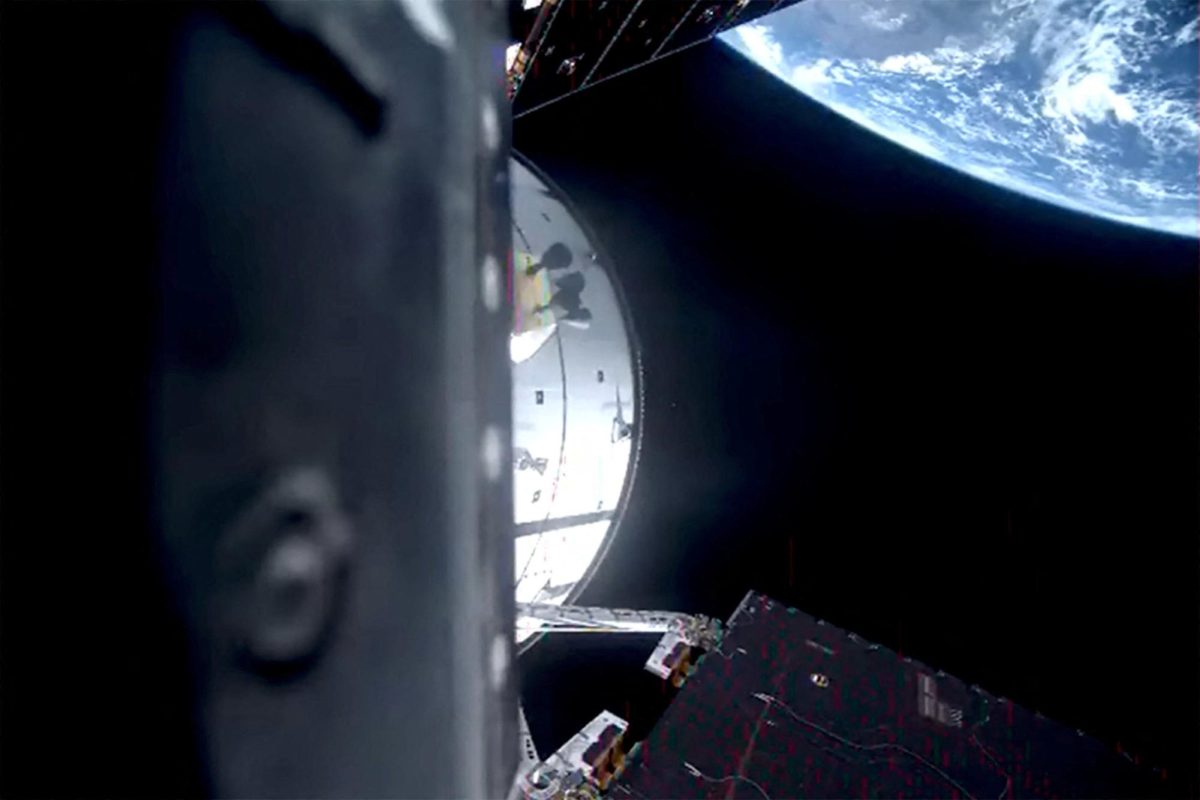
The four-person crew consisting of NASA astronauts Reid Wiseman, Victor Glover, Christina Koch, and the Canadian Space Agency astronaut Jeremy Hansen launched aboard Orion on April 1, 2026, and splashed down in the Pacific Ocean safely on April 10 after a 10-day mission.
Kai Cortadellas ’28 reflected on the moment: “I have been following all the NASA manned spaceflight programs for as long as I can remember, and finally being able to see with my own eyes exactly what those years of anticipation led to was an incredible experience.”
Unlike future Artemis flights, Artemis II was not designed to land on the Moon, as its primary purpose was to test whether the systems needed for human deep-space travel are ready to carry astronauts safely farther from Earth again. Artemis II was not only historic, but very much essential for future goals of the Artemis Program. After numerous simulations and uncrewed tests, real conditions beyond low Earth orbit were tested by NASA with the flight designed to confirm that Orion, the Space Launch System, and mission operations can support astronauts in deep space.

Diagram of the Artemis II mission’s flight path. NASA, Public domain, via Wikimedia Commons
https://biologos.org/post/artemis-ii-and-our-faith-why-we-reach-for-the-stars
Radiation: From Concept to Reality
The mission also pushed human spaceflight back into a much harsher environment. As soon as the crew moved beyond Earth’s protective magnetic field, they entered a region where radiation and solar activity became far more serious concerns. As also detailed in my linked column, with the Artemis II mission, radiation is no longer just a concept to understand, but it is an active risk that must be monitored, measured, and managed in real time. To reduce that risk, NASA tracked solar activity continuously throughout the mission and equipped both the astronauts and the Orion capsule with radiation sensors. These details may seem small, but they reflect a major shift in how space missions are conducted.
Beyond Engineering: The Role of Data and Biology
Modern exploration is not only about rockets and spacecraft, as it also depends just as much on gathered data, prediction, and constant awareness of the perilous space environment. Artemis II also carried out important research focused on astronaut health. One notable investigation, AVATAR, uses organ-on-a-chip technology to study how radiation and microgravity affect human tissue. These chips contained cells derived from the Artemis II astronauts and traveled alongside the crew, allowing scientists to observe how the human body responds to deep-space conditions in real time. Research like this could play a key role in protecting astronauts on future missions to the Moon, Mars, and beyond, while also advancing medical science here on Earth.
Bridging the Past and the Future
What makes Artemis II especially significant is that it bridges the past missions and the future ones. Apollo missions proved that humans could reach the Moon, despite operating with technology a fraction of what exists today. However, humanity learned much from those missions, and Artemis II demonstrates that we are learning how to do it again, with more advanced technology, stronger safety systems, and a focus on long-term exploration rather than short-term missions.
Looking Ahead
The mission does not mean in any way that every challenge has been solved yet. Radiation exposure, astronaut health, and long-duration survival in deep space still remain as concerning major obstacles. However, the successful Artemis II mission critically proves that returning humans to deep space is no longer a distant goal but already underway.
In the end, Artemis II matters immensely because it makes the future of exploration tangible to humanity again. It was not just a symbolic flyby around the Moon, but a mission designed to test systems, gather data, and prepare for what comes next. If Artemis I proved that the hardware could fly, Artemis II showed that humans are ready to follow.
As part of a generation that had the privilege of witnessing this historic mission, it is exciting to know that this time, we are not just going back; we are preparing to go farther than ever before.
Sources:
https://www.nasa.gov/humans-in-space/artemis/#:~:text=Missions-,Artemis%20I,Ground%20Systems
https://www.nasa.gov/news-release/nasa-welcomes-record-setting-artemis-ii-moonfarers-back-to-earth/
https://www.nasa.gov/missions/nasa-answers-your-most-pressing-artemis-ii-questions/
https://science.nasa.gov/biological-physical/investigations/avatar/