

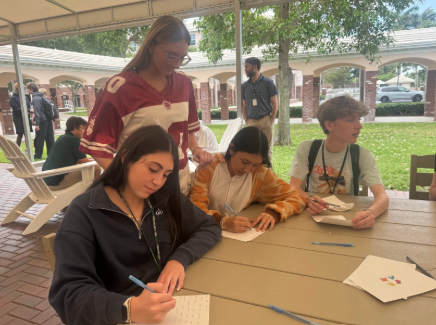








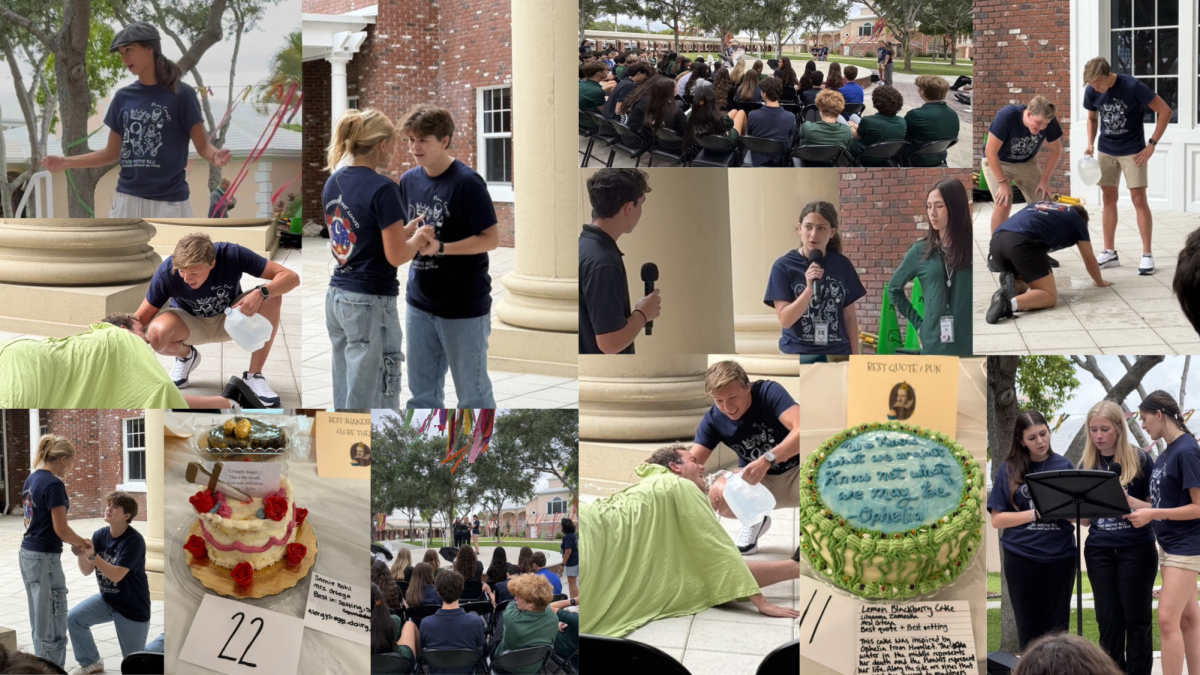




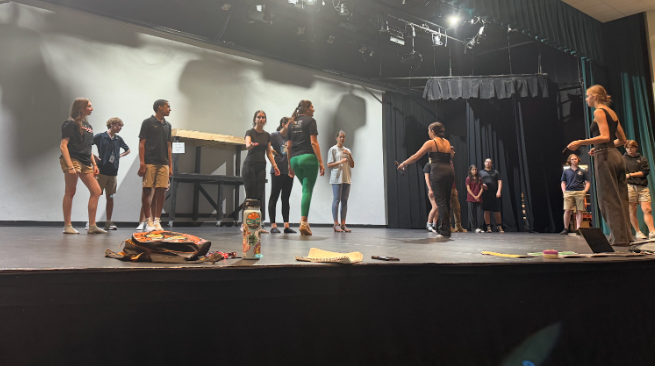



























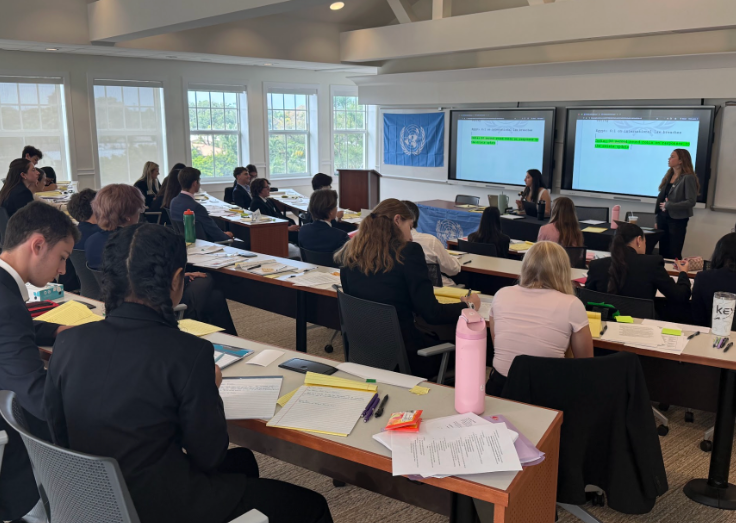
On April 16, 2026, the Pine Crest Model United Nations team hosted a Security Council committee, the first of its kind this year. Delegates from fifteen different countries, with two representatives per nation, engaged in fast-paced debate, delivered speeches, drafted resolutions, and collaborated to address a complex global crisis. This year’s committee focused on the 2026 Iran War, also known as Operation Epic Fury, with goals to coordinate a ceasefire and produce a comprehensive resolution.
The countries represented included the United States, the United Kingdom, France, Israel, Turkey, Russia, China, Iraq, Iran, Pakistan, India, South Africa, Qatar, Saudi Arabia, and the United Arab Emirates. Each delegation entered with its own alliances and priorities, reflecting real-world geopolitical tensions. Part of what made the conference especially intense was the challenge of building relationships and finding common resolution while still remaining true to each country’s core beliefs.
Throughout the conference, delegates tackled major issues such as economic instability in the Strait of Hormuz, the maintenance of open trade routes, refugee crises, and human rights concerns. As the situation evolved, participants constantly adjusted their strategies in response to new developments.
What set this conference apart was its crisis component. Unlike traditional committees, the Security Council included a crisis backroom where delegates could send directives and influence events in real time. These actions contributed to ongoing Crisis Updates, released through breaking news alerts, simulated tweets, protests, and AI videos. As Andrew Mints ’29, who represented Turkey, explained, “more ‘news’ is ‘released’ during the conference that shows how each delegation’s notes have come together to create a fictional narrative.”
The dynamic nature of these updates required constant adaptability under pressure. Mints reflected on this challenge, describing it as “recovering from and adapting to Crisis Updates,” a process that demanded quick thinking and strategic flexibility.
This need for flexibility was echoed by Vidhya Gupta ’28, a representative of China, who explained that “adaptability played a major role,” especially when delegates had to “think quickly, deliver clear speeches … and incorporate those changes into my resolutions.”
At the same time, success in the committee depended heavily on collaboration and long-term strategy. Dylan Gray ’27, who represented India, emphasized the importance of relationships, stating that “alliances are everything and who you know matters most.” His experience highlights how diplomacy extended beyond formal debate, shaping the final outcome through trust and coordination between delegations and blocs.
Reaching consensus, however, was not always straightforward. Griffin Albanese ’27 pointed to the complexity of balancing competing interests, explaining that one of the most difficult aspects was “working with everyone at once to find a goal we all agreed on and was acceptable for various competing interests.” This challenge underscored the realism of the council and the difficulty of global decision-making and diplomacy.
This level of complexity reflects how the Security Council builds on earlier Model United Nations experiences throughout the year. The conference marked the third MUN event, following PCMUNC, which was open to all members, and WAMUNC, a selective conference held in Washington, D.C. In comparison, the Security Council provided a more advanced and immersive experience, requiring real-time decision-making in a high-pressure environment.
This intensity carried through to the outcome, as the conference concluded with the successful passage of a resolution addressing the crisis and establishing a ceasefire. Across different blocs, with varying priorities, delegates worked together to refine their ideas and reach a unified solution.
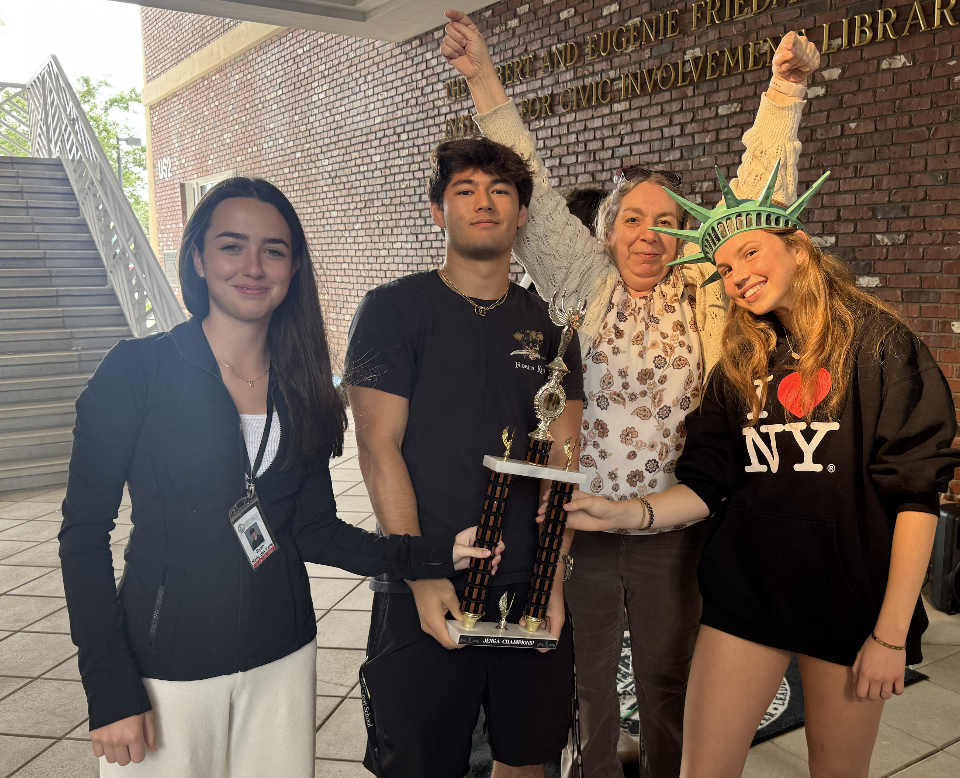
Several delegations were recognized for their exceptional performance. Best Delegate honors were awarded to the delegation representing Russia, Benjamin Berer ’28 and Neil Rai ’28, the delegation representing India, Dylan Gray ’27 and Griffin Albanese ’27, and the delegation representing Iraq, Sofia Balan ’26 and Ethan Fischbein ’29.
Honorable Mentions were awarded to the delegation representing Pakistan, Emma Llorente ’28 and Zoraida de Souza ’29, and the delegation representing China, Vidhya Gupta ’28 and Lilyanna Zameska ’28.
Overall, Pine Crest’s Security Council highlighted the team’s ability to think critically, adapt under pressure, and navigate complex global issues, reflecting both the intensity and the realism of high-level international diplomacy. The team now looks ahead to next year, eager to see what new conferences and opportunities lie ahead.