
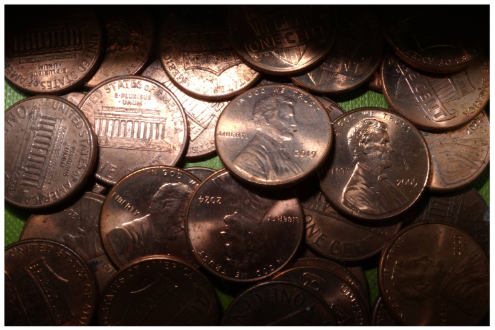
Piggy banks are a core childhood memory for most individuals. Slowly adding pennies and gradually hearing the clinking of the Piggy Bank filling up are unforgettable moments for most children. Throughout American history and pop culture, references to the penny abound. In fact, the “penny” sayings are integrated into our daily lives. Some references include: “a penny for your thoughts”, “that costs a pretty penny”, “don’t be penny-wise and pound-foolish,” that is “worth every penny”, “See a penny, pick it up, all day long you’ll have good luck.” This is just a small sampling of the beloved quotes, citations, and adages our society embraces regarding the penny. References to the penny are often interwoven into folklore, proverbs, symbolism, and, at this point, the national fabric. If you pause and think about it, even the word penny seems old-fashioned. Of course, the penny’s use as part of the national currency for over two hundred years suggests it is interwoven into our economy, or is it? When the country does away with the penny, an eventual outcome now that production has ceased, are communities affected?
These are some of the questions posed by the United States Secretary of the Treasury’s decision to halt the minting of the penny. When the U.S. Department of the Treasury announced its decision to suspend production of the penny, the agency provided the rationale: production costs per penny rose from 1.42 cents to 3.69 cents. Not surprisingly, the many production costs have been escalating over time. The decision was made that it was not fiscally responsible or necessary to continue spending taxpayer money on the minting of pennies; an estimated $56 million will be saved by suspending penny production. While pennies are, currently, still an acceptable form of currency, with no federal or state legislation to discontinue their use, eventually they will fall out of circulation. Due to pennies being readily lost or overlooked, that circulation time frame might speed up. At that point, and in the absence of clarity through firm legislation, it will be up to companies, vendors, and merchants to round the sales price either up or down to the nearest five-cent increment for those customers paying in cash. As of right now, in the state of Florida and many other states, there are proposed bills emphasizing the rounding for cash users only. For example, there will be no rounding needed for consumer payments made with a check, debit card, or credit card. This poses the new question: Is it fair that only cash users are upcharged or rounded down? In fact, some local businesses are already not accepting pennies as a form of payment, or rounding up the costs so customers are required to pay in five-cent increments.
While there has been news coverage of Scott Bessent’s, the United States Secretary of the Treasury, decision to cease production of the penny, is the significance of this decision more nostalgic or tangible in effect? Perhaps it depends on who you ask. Richard Landa ‘26, a Pine Crest student, noted, “The penny was a very important piece of US history, though as time changes, digital currency has brought about an era in which small coins are no longer needed.” While Pine Crest student Alexander Llorente ‘26 generally agreed with that sentiment, he also remarked, “Although the penny has widely become obsolete due to new advancements in technology, for communities where technology is not as readily accessible, or there is a priority placed on the use of physical currency, this could pose a potential challenge.” Taking all of this into consideration, the pending question is whether the momentum to move towards a cashless society will continue, and if so, whether that will negatively affect communities where technology, credit cards, and bank cards are not as easy to obtain. Only time will tell.