
As science and technology continue to shape almost every aspect of modern life around us, student innovation projects are beginning to mirror that same level of curiosity, complexity, and urgency needed. The strongest STEM projects of 2025 stand out not just because of the age of their creators, but also because they reflect a deeper shift in how these young students approach problem-solving. Increasingly, students are no longer treating STEM as an academic exercise, as they are using it as a tool to engage directly to help solve real-world challenges. By doing so, they are beginning to blur the line between just learning and actually contributing, suggesting that innovation is no longer something reserved for the future, but something already in progress at our level.
One of the clearest examples is Miles Wu, a 14-year-old student whose work was featured by Smithsonian Magazine. Wu explored how origami-inspired folding patterns, especially the Miura-ori fold, could help design compact, lightweight, and durable emergency shelters in disaster situations. According to the article, he spent more than 250 hours relentlessly testing 54 designs, and finally, one of his structures was able to support roughly 10,000 times its own weight. Rather than treating origami as just a hobby or an art form alone, Wu turned it into a structural engineering challenge, asking the question of how folded materials can become stronger, more efficient, useful, and applicable in the real world.
The Miura-ori fold is a rigid, tessellated origami technique developed by Japanese astrophysicist Koryo Miura, which allows a large surface area, such as a solar panel or map, to be compressed into a compact shape and fully deployed in one motion. It is renowned for high structural efficiency, requiring minimal force to expand, with practical applications in space exploration and packaging.
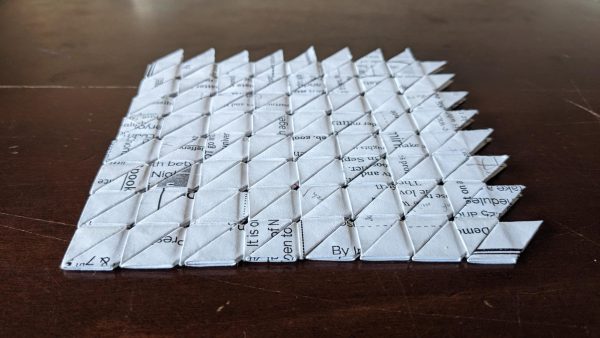
A mesh made of origami Fork modules
https://commons.wikimedia.org/wiki/File:Flat_Mesh_of_Origami_Fork_Modules.jpg
Innovation Beyond the Classroom
Projects like Wu’s reflect a larger shift in student STEM work. In the past, student science projects were often seen as merely simplified and basic demonstrations of ideas already well understood by adults. Today, however, many student researchers are moving beyond such basic models and into areas that resemble real engineering and scientific investigation. In this way, innovation is becoming less about age or credentials and more about an unwavering mindset.
Dr. Katherine Ganden, Assistant Head of Science Research at Pine Crest School, explained, “Science fairs are no longer about confirming what we already know. Instead, student research projects should be about experiencing how science actually works. That means asking real questions, getting stuck, revising your approach, and figuring out what your data actually tells you. The best kinds of projects are rooted in existing research but are extended in novel, meaningful directions. For example, one student this year read about low-cost eDNA samplers used to measure biodiversity in rural ecosystems and began wondering whether a similar tool could be adapted for public health surveillance in low-income communities. Her project required an understanding of engineering, epidemiology, microbiology, and bioinformatics. This kind of interdisciplinary thinking is exactly what we want to encourage as students consider how to approach real-world problems. But it is not just about the lab work. Students must be able to explain their findings clearly and effectively. At the end of the day, even the most brilliant, innovative idea won’t have an impact if nobody can understand what you’re talking about.”
Such a pattern was especially visible at the 2025 Regeneron International Science and Engineering Fair, where top student projects focused on challenges like antiviral drug development, assistive prosthetic technology, environmental monitoring, and new uses for recycled materials. These projects were not impressive only because they were technically difficult; they were rather impressive because they showed how young researchers are beginning to connect scientific knowledge with actual human needs. In many cases, the goal was not simply to prove a concept but to solve the problem itself.
A More Interdisciplinary Future
Beyond their technical achievement, what makes these projects especially important is the way they also cross the boundaries between different fields. Origami becomes structural design, waste recycling becomes materials engineering, brain signals become a pathway toward prosthetic control, and so on. The best projects of 2025 suggest that the future of STEM will belong to people who can think across different disciplines rather than staying inside just one.
This interdisciplinary pattern very much matters because many of the problems facing our modern world do not fit neatly into a single category. Climate change, public health, accessibility, and infrastructure all require collaboration between science, engineering, technology, and design. The analysis of these projects reveals that today’s student innovators are already beginning to reflect that reality much earlier than many people expect.
Why Student Work Matters
There is also a larger message behind these projects. They show that meaningful innovation does not have to wait until our college or professional research years. Strong ideas can begin with our curiosity, persistence, and the willingness to test an unusual concept seriously and with diligence, despite obstacles that are put in front of us. In that sense, the most exciting student STEM projects are not simply competition entries. They are early signs of how the next generation of us may approach the world’s biggest challenges. At the same time, many of these projects remain early-stage challenges and, unfortunately, depend heavily on limited access to available resources, mentorship, and further development to reach real-world implementation.
As Nikhil Chawla ’28 explained, “Student STEM projects can make real differences in the world. Projects are no longer just simple demonstrations. Now, these innovations can create real differences in the world.”
If the best student STEM projects of 2025 reveal anything, it is that the future of innovation will not be defined solely by advanced degrees or professional experience, but by the ability to think across disciplines, identify meaningful problems, and pursue creative and unconventional solutions with persistence. While many of these ideas are still in early stages and require further development to reach real-world scale, they represent something much more important: a shift in mindset. These students are not waiting to become scientists or engineers; they are already beginning to act like them. In that sense, their work is not just a demonstration of what is to come, but an early sign that the next generation of innovation is already underway in meaningful and measurable ways.
Sources
https://www.societyforscience.org/press-release/regeneron-isef-2025-full-awards/
https://en.wikipedia.org/wiki/Miura_fold